
If you lead a B2B revenue team, you’ve probably heard some version of this in the last year:
“iOS call screening has killed outbound.” “AI has flooded buyers with outreach – nobody wants to pick up the phone anymore.”
The logic sounds convincing. Apple keeps tightening call screening. AI-generated emails and sequences are everywhere. Prospects are fatigued, guarded, and harder to reach than ever.
But here’s what’s actually happening where it matters most: when you do get a real decision maker on the phone, conversion rates are going up, not down.
At Superhuman Prospecting, decision-maker-to-appointment rates have doubled since 2024, even in the face of new iOS 26 call screening rules and the explosion of AI-powered outreach. In 2024, about 11% of decision-maker conversations turned into meetings. By early 2025, that hovered around 13%. In January 2026, that number hit 22% – roughly one in five decision-maker connects turning into an appointment.
For B2B business owners, sales leaders, and marketing executives, the takeaway is strategic:
- Cold calling is harder to initiate, but more valuable when it lands.
- In a market drowning in automation, human-to-human (H2H) conversations have become a premium asset.
- Teams who know how to run true H2H cold calls are quietly gaining a serious competitive edge in pipeline creation.
Let’s unpack what’s changed, why human connection is converting better than ever, and how to operationalize it in 2026 and beyond.
The New Reality: iOS 26, AI, and a Tougher Outbound Environment
First, it’s fair to acknowledge the headwinds.
Apple has steadily expanded features that allow users to screen, filter, and block unknown or suspected spam calls – including silencing calls from unknown numbers, using carrier spam labels, and giving users more control over who gets through. With iOS 26, call screening and spam detection have tightened further, with greater emphasis on caller ID reputation, pattern recognition, and spam/fraud labeling by carriers and apps. [2] [3] [4]
For outbound teams, this means:
- Fewer calls ringing through to mobile users
- More calls flagged or silently routed to voicemail
- Greater sensitivity to caller ID reputation and dialing practices
Layer on top of that the rise of AI: automated email cadences, AI-written LinkedIn messages, and even AI voice agents. Prospects are hit with more outreach than ever – much of it generic, impersonal, and easy to ignore. Digital fatigue is real.
So yes, connect rates are under pressure. It’s harder to simply “spray and pray” with dials and expect volume alone to carry you.
But that’s only half the story.
What Happens When You Actually Reach a Decision Maker
The more important question is: What happens when someone actually answers?
Superhuman Prospecting studied appointment-setting performance based on decision-maker connections from 2024 through January 2026. Instead of looking at dials-to-meetings (which is heavily affected by iOS and spam filtering), the focus was:
“When a true decision maker answers the phone and engages, how often does that call turn into a meeting?”
The findings:
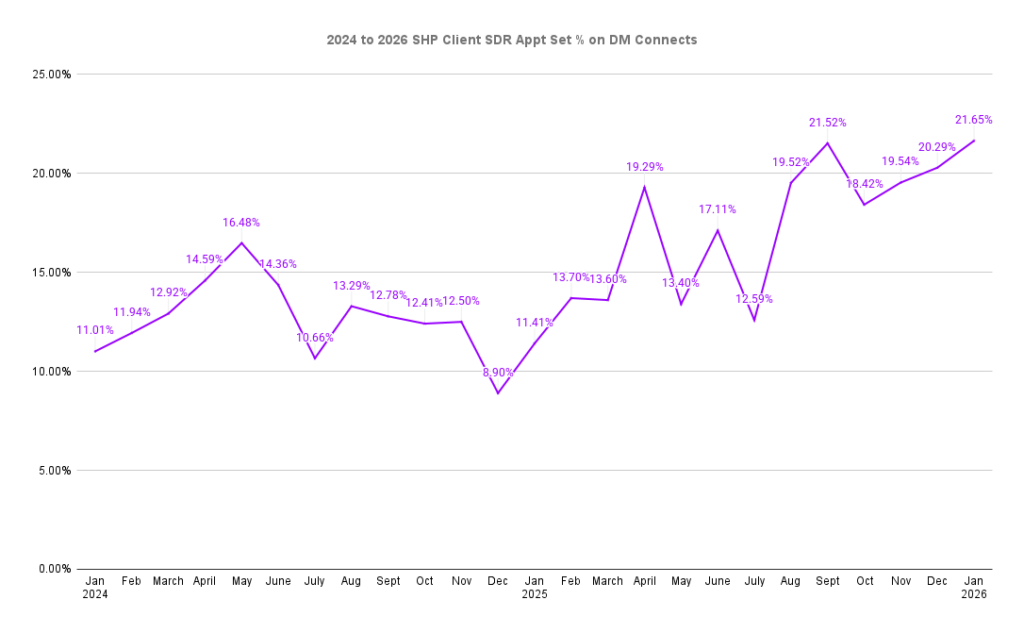
- 2024: Around 11% of decision-maker connects converted into appointments – roughly one in nine conversations.
- 2024 into Spring 2025: That rate climbed and stabilized around 13%.
- January 2026: Conversion spiked to 22% – about one in five decision-maker conversations turning into a booked meeting.
That’s a dramatic efficiency gain at the exact point of highest leverage: live conversations with the right person.
To put this in context with broader industry benchmarks:
- Gartner reports that high-growth organizations convert 15.2% of live connects into meetings scheduled. The firm notes this as a key gap between average and top-quartile performance.
- The Bridge Group’s 2024 SDR Metrics & Compensation Report finds that outbound SDRs average 3.6 Quality Conversations per day, and top-performing orgs maintain a 12–15% Quality Conversation-to-Meeting conversion rate.
- HubSpot’s 2024 State of Sales benchmarks show that meaningful connection-to-qualified-opportunity rates in relationship-driven and professional services sales typically sit between 10–15%.
Against that backdrop, a 22% decision-maker-to-appointment rate doesn’t just look healthy – it’s elite.
And it tells us something important about the market: When buyers are burned out on digital noise and AI-driven outreach, a real, relevant, human conversation is more likely than ever to move them to a next step.
Why Prospects Are Craving Human Connection Again
On the surface, it may seem paradoxical: more technology, more automation… and more appetite for phone conversations?
But when you look at the buyer’s experience, it tracks.
Every day, your prospects are:
- Deleting AI-generated emails that all read the same
- Ignoring automated LinkedIn sequences
- Clicking “unsubscribe” on nurture flows they never really engaged with
- Getting bombarded by chatbots and in-product popups
The net effect is over-digitization and over-automation. Buyers are past “fatigue”; they’re often in full-on defensive mode. They assume most outreach is low-effort and low-relevance until proven otherwise.
In that environment, a thoughtfully executed cold call becomes:
- A pattern interrupt in a sea of text-based automation
- A chance to map nuance: tone, hesitation, curiosity – things no email can convey
- A rare moment for buyers to vent real challenges, ask questions, and test whether a vendor actually “gets it”
This is exactly what Superhuman Prospecting has observed: after a period of AI inundation and digital overload, prospects are more willing to engage in a genuine, unscripted conversation – if the caller shows up as a real person, not a robotic pitch machine.
The technology arms race has unintentionally made human connection a differentiator.
The H2H Method: Cold Calling as Human-to-Human, Not Script-to-Prospect
The jump from 11% to 22% conversion in decision-maker conversations didn’t happen by accident. It’s closely tied to how those calls are being conducted.
Superhuman Prospecting’s callers are trained and coached on The H2H Method – a proprietary, human-to-human sales scripting and conversation system designed to help SDRs and callers double industry averages by focusing on authentic, relevant, and trust-building interactions rather than rigid pitches.
At its core, the H2H approach looks very different from traditional “Smile and Dial” tactics:
- Human-first framing: Reps are encouraged to bring their own personality and preferences to the conversation, so calls feel like two people talking, not one person reading.
- Conversation over monologue: The goal is a quality conversation, not a perfectly delivered script. The script is a framework, not a cage.
- Empathy and context: Instead of bulldozing through an opener, callers acknowledge the interruption, ask permission to continue, and quickly anchor the call in the prospect’s world, not just the product.
- Micro-commitments, not pressure: The “ask” is framed as a logical next step – a short, low-friction meeting to explore fit – not a high-pressure close.
The CEO behind this methodology is quick to credit his team: they’re not just following H2H mechanically; they’re deploying real skills – active listening, tone control, situational awareness, objection handling – and layering those on top of the framework.
But the broader market signal is hard to ignore:
In a world where AI can generate endless words, buyers now value conversations that clearly could not have been automated. That’s precisely what a well-executed H2H cold call delivers.
Strategic Implications for B2B Revenue Leaders
For VPs of Sales, VPs of Marketing, and founders who own the number, these trends should prompt a strategic re-think of cold calling’s role in your go-to-market.1. Shift your lens from “dials” to “decision-maker conversations.” The old KPIs – raw dials per day, talk time for its own sake – don’t reflect reality under iOS 26 and modern call screening. You need to measure:
- How many true decision makers you’re connecting with
- What percentage of those conversations are quality conversations (not just “Hello, not interested, click”)
- How many of those quality conversations turn into appointments or qualified opportunities
That’s where the leverage is. If your team can move decision-maker-to-meeting conversion from 10% to 20%+, your pipeline picture changes dramatically even if connect rates stay flat or slightly decline. 2. Treat human conversations as a scarce, high-value asset. If connect rates are harder to come by, the conversations you do get are more precious. That means:
- No more sending undertrained reps into live calls with rigid, unnatural scripts
- No more treating cold calling as an entry-level “burnout” channel
- A renewed focus on coaching, call reviews, and H2H-style frameworks that maximize each opportunity
3. Position cold calling as a strategic complement to digital, not a relic. Your buyers don’t live in one channel. They see your emails, your LinkedIn content, your ads – and then they may pick up when they recognize your brand name or problem statement on a caller ID or voicemail. When aligned:
- Calls reinforce and personalize messages buyers have seen elsewhere
- Reps can reference content or signals (“I saw you downloaded…”, “I noticed your team is hiring AEs…”)
- The phone becomes the bridge between digital intent and real opportunity
In short: Cold calling isn’t competing with digital – it’s the human validation layer on top of it.
Implementing H2H Cold Calling in the iOS 26 Era
Knowing that human-to-human cold calling works is one thing. Operationalizing it inside a B2B org is another. Here are key considerations if you want to replicate these gains.Redefine your success metrics. Start by tracking the right numbers:
- Decision-maker contacts per rep per day
- Quality conversations (with a standard definition)
- Decision-maker conversation-to-meeting rate
- Meeting-to-opportunity and opportunity-to-revenue downstream
This lets you see clearly whether your challenge is connect rate, conversation quality, or conversion skill. Adopt an H2H-style framework, not a rigid script. Give your team a structured but flexible calling methodology that:
- Provides proven openers, talk tracks, and objection handling language
- Encourages personalization and natural language instead of word-for-word recitation
- Emphasizes curiosity, discovery, and relevance over features and monologues
Think of it as a conversation design system, not a script document. Invest in live-call skills, not just sequencing tools. Many orgs have over-rotated into tech and under-invested in actual selling. To reverse that:
- Run regular call listening and feedback sessions
- Coach on tone, pacing, permission-based language, and how to rescue a call that starts poorly
- Celebrate quality conversations and learning, not just booked meetings
If your reps sound like humans, not tools, your conversion rates will reflect it. Adapt your operations to the iOS 26 landscape. You can’t control every filter, but you can stack the odds in your favor:
- Maintain a clean, permission-aware prospect database and respect opt-outs
- Monitor and protect your caller ID reputation – high complaint rates will hurt your connect rates even more [2] [3]
- Use clear, recognizable caller IDs and ensure your messaging early in the call answers the prospect’s unspoken “Who is this and why are you calling me?” fast
The goal isn’t to “hack” the system, but to behave like the kind of caller users and platforms want to allow through.
The Competitive Advantage: Human Connection as a Moat
As AI continues to improve and digital channels become even more saturated, there’s a real risk that many teams end up competing in a race to the bottom on automation: more emails, more sequences, more bots.
The organizations that will stand out are those that:
- Use AI and automation to augment, not replace, human selling
- Reserve human conversations for the highest-value moments – and execute them at a very high skill level
- Treat H2H cold calling as a core strategic capability, not a legacy afterthought
In that world, a team that can convert 20%+ of decision-maker conversations into qualified meetings has a defensible edge. Your competitors may be sending more emails, but you’re having more real conversations – and those conversations are turning into pipeline at a higher rate.
Cold calling is not dying. It’s evolving. The winners will be the ones who lean into humanity, not away from it.